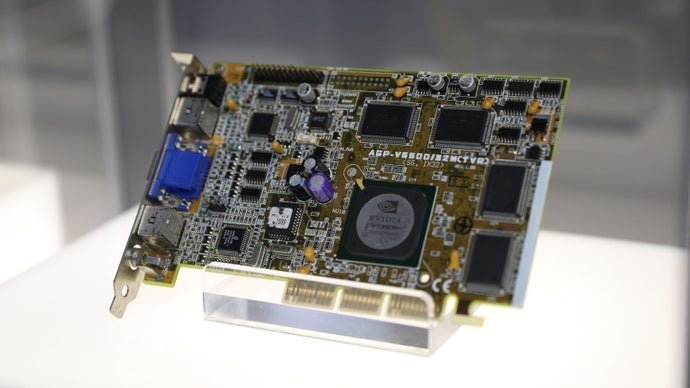
The PC graphics market of 1998 bore little resemblance to today's landscape. Back then, choosing a 3D graphics card meant navigating a field of 47 competing companies, each offering reasonably priced options. The market had exploded to 130 million units annually, outselling PCs themselves. Yet within just four years, that abundance had vanished. By 2002, only two survivors remained: Nvidia and ATI, which later became part of AMD.
The scale of that consolidation becomes clear when examining the market leaders at the time. In 1998, ATI dominated with 24.5 million 3D chips sold, followed by S3 with 15.2 million units. Intel, entering the market for the first time, shipped 6.5 million chips. Nvidia ranked fourth with 6.4 million, while 3dfx, the legendary maker of Voodoo cards that had pioneered 3D gaming on PC, sold 5.2 million. None of these positions guaranteed survival.
The transition from 1998 to 2002 fundamentally changed what the graphics business rewarded. Speed alone no longer mattered. Instead, the market favoured companies capable of releasing new chips every six months, backed by sufficient capital to weather the dot-com crash. Nvidia proved built for this relentless pace. Almost every competitor was not.
The Cost of Transition
The shift from 2D to 3D graphics imposed brutal costs on established players. Designing 3D acceleration chips required far more resources than their 2D predecessors, and many incumbents lacked the financial reserves to make the transition. Tseng Labs, a respected name in graphics, ceased chip development at the end of 1997 despite holding roughly $28 million in the bank. Rather than continue, it sold its graphics engineers to ATI for about $3 million. Rendition, maker of the Vérité V1000 3D accelerator, agreed to be acquired by memory manufacturer Micron in June 1998. That October, ATI purchased Chromatic Research for $67 million.
Nvidia's January 1999 IPO prospectus revealed the brutal schedule driving the industry. PC makers introduced new systems twice yearly, on spring and fall cycles, and missing either window meant losing design wins. Nvidia reorganised itself around this schedule, launching the GeForce 256 in October 1999 and the GeForce 3 in February 2001. By 2002, the company disclosed that separate design teams were working on multiple chip generations simultaneously.
S3, then the world's second-largest graphics chip maker, acknowledged the trap in its 1999 annual report. Graphics chips remained on sale for 12 to 18 months, and even a delay of a few months could cost critical design wins. Any company releasing just one major chip annually faced rivals refreshing their lineups at best, or launching against next-generation products at worst. The mathematics were unforgiving.
3dfx's Fatal Mistakes
3dfx exemplified how quickly dominance could evaporate. The company's planned successor to the Voodoo5, codenamed Rampage, never shipped. Simultaneously, 3dfx lost its technological moat. Glide, its proprietary programming interface that only ran on Voodoo cards, had thrived while Microsoft's Direct3D remained feature-incomplete. But once Direct3D and OpenGL drivers matured, developers could write once and run everywhere. By 1999, Creative was selling Nvidia-based Riva TNT cards with drivers enabling Glide games to run on them. 3dfx sued, then open-sourced Glide that December.
Yet 3dfx had already inflicted the wound that would prove fatal. On December 14, 1998, it agreed to acquire graphics card maker STB Systems for approximately $141 million in stock. CEO Greg Ballard declared that the Voodoo3 would be sold exclusively on 3dfx's own cards. This revelation devastated Diamond and Creative, which had built their gaming lines around Voodoo chips and now faced exclusion from the next generation.
3dfx's reasoning centred on margin protection. The Voodoo Banshee's price had plummeted from $150 to $89 within a month of launch. By selling finished cards directly, 3dfx captured margins that would otherwise flow to partners like Diamond or Creative. Those boardmakers inevitably departed. STB had been selling Nvidia chips until the acquisition, and its financial records showed a $3 million note from Nvidia Corporation. Creative already had Riva TNT cards in stock. Nvidia, which did not manufacture its own cards at the time, sold chips to anyone willing to buy.
Intel's Disruptive Entry
Intel created chaos from the opposite end of the market. Its i740 "Auburn" graphics chip launched in early 1998. Industry observers noted that Intel's arrival prompted Cirrus Logic, Oak, and others to exit that year. Just over a year later, following disappointing sales, Intel ended i740 support and withdrew from standalone desktop graphics to embed graphics into motherboard chipsets instead, beginning with the i810.
This pivot proved catastrophic for companies like S3, Trident, and SiS, which depended on selling cheap chips to major PC manufacturers. By the second half of 2001, Intel's integrated graphics business controlled an estimated 55 percent of the market. S3 responded by selling its graphics division to a VIA joint venture for $323 million, effectively surrendering the consumer segment.
The Collapse and Consolidation
Venture funding for graphics startups had already dried up in 1999 as the dot-com bubble deflated. Exits followed swiftly. 3dfx lost $100.5 million in the second quarter of 2000, with its CEO blaming the delayed Voodoo5. On December 15 that year, unable to secure credit, 3dfx sold its assets to Nvidia for $70 million in cash plus one million Nvidia shares. STMicroelectronics, which produced the PowerVR-based Kyro II, quit PC graphics in early 2002.
ATI survived the carnage because it had already adapted to the new market's demands. As the largest seller at the time, ATI manufactured its own graphics cards, which generated most of its revenue and profit margins. Making cards was not inherently wrong; 3dfx's mistake was locking out the boardmakers who had been selling Voodoo cards, pushing them toward Nvidia. A late Voodoo5 and a cash crisis delivered the final blow. ATI also acquired talent from failing competitors, purchasing Tseng's engineers, then Chromatic's team, and in February 2000, ArtX for $400 million—the team that had designed the Flipper graphics chip for Nintendo's GameCube.
Two Decades of Duopoly
For the next twenty years, ATI and Nvidia dominated the graphics industry. ATI eventually merged into AMD in 2006. Competition remained intense for a time; AMD paid $5.4 billion for ATI, and in the second quarter of 2010, Radeon cards briefly surpassed Nvidia in discrete graphics shipments. However, AMD discovered it could not afford the acquisition. It wrote off $1.6 billion in goodwill about a year after closing the deal, and its PC chip business continued to struggle.
By early 2015, AMD's combined CPU and GPU revenue had declined 38 percent year-over-year, and the company approached negative book value. Quarterly R&D spending fell to its lowest level since 2004, while Nvidia spent nearly half again as much. Radeon cards remained on the same Graphics Core Next architecture for approximately seven years before RDNA arrived in 2019. By then, Nvidia had already launched RTX cards with dedicated ray tracing hardware and Tensor cores for AI work, establishing a lead it never relinquished.
Intel's Attempted Return
Intel possessed the only balance sheet deep enough to challenge the duopoly. Its first attempt, Larrabee, was cancelled as a consumer graphics chip in December 2009. The company finally re-entered in 2022, when the Arc A770 launched at $329, alongside the cheaper A750. Both cards arrived after repeated delays and struggled with older DirectX 9 games. Industry observers, including specialists at the outlet covering this sector, assessed their chances of breaking the Nvidia-AMD duopoly as low. By 2023, Intel had drastically improved its drivers, delivering substantial gains in both general performance and DirectX 9 compatibility, though the Arc series still required months of updates to reach acceptable stability.
The second generation performed better. The Arc B580 successfully sold out at $249 in December 2024. Yet this success barely registered industry-wide. In the third quarter of 2025, Intel held just 1 percent of graphics card shipments, rising to around 2 percent in spring 2025, when Nvidia captured roughly 90 percent of the 12.5 million cards shipped.
Intel now appears to be exiting gaming graphics cards. In April 2025, leaker Jaykihn claimed that the next-generation Celestial gaming cards had been cancelled long ago, with rumours suggesting B580 supply could be cut to free capacity for Arc Pro cards targeting AI workloads. Intel has not confirmed these reports, and company executives have stated that Arc remains on the PC roadmap. Yet Intel possessed everything 3dfx lacked: cash, relationships with PC makers, and access to the same APIs as competitors. Money alone cannot replicate two decades of driver refinement, and Intel appears to have concluded that AI represents a better use of its capital.
The graphics industry's consolidation from 47 competitors to two reflects no single cause. Some companies could not afford rising development costs. Others could not match Nvidia's six-month release cycle. Some lost their cheap-chip business to Intel's integrated graphics, while others collapsed when venture funding evaporated. What remained was a Nvidia-AMD duopoly that has not served PC gamers well. The RTX 4080 launched at $1,199 in 2022, nearly double the RTX 3080's price, and AI-driven RAM shortages have pushed prices higher still. In 1998, 47 companies competed for consumer money. Today, two remain, with Nvidia selling nine of every ten cards while earning most of its revenue from data centres.
Related Articles
About the Author