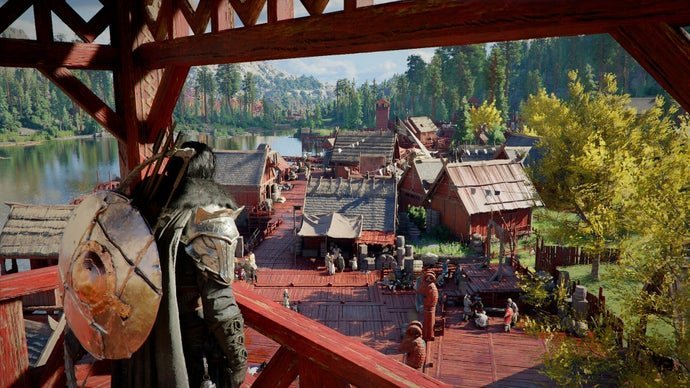
Pearl Abyss leadership has suggested that critical reviews of Crimson Desert scored lower than user ratings because reviewers lacked sufficient time to fully experience the game's world and hidden details during their evaluation periods.
Lybee Park, European CEO of the developer, explained in a recent interview that critics received incomplete builds and faced strict time constraints while preparing their assessments. She noted that reviewers typically follow the main quest line rather than exploring the broader game world where much of the experience's distinctive appeal resides. According to Park, this limited access prevented critics from discovering the numerous small details scattered throughout the environment that contribute to the game's intended impact.
The Reality of Review Timelines
Park's observation about time pressure contains a kernel of truth. Critics frequently operate under severe deadlines when evaluating games, often receiving access codes only days before launch or, in some cases, even later. This compressed schedule can significantly shape how a reviewer experiences a title, particularly one as expansive as Crimson Desert. A player rushing through a game to meet a publication deadline will inevitably have a different perspective than someone taking their time to absorb every element at a leisurely pace.
The disparity between critic and player experiences becomes more pronounced with large open-world titles where the intended experience involves exploration and discovery rather than linear progression. A reviewer following the critical path to meet their deadline may miss contextual details that casual players would naturally encounter through unhurried play.
Who Controls the Timeline?
However, Park's explanation glosses over a fundamental question: who decides how much time critics receive? The developer itself controls when review codes are distributed and under what conditions. Pearl Abyss, as the studio behind Crimson Desert, bears responsibility for the review timeline constraints that Park now cites as an explanation for lower critical scores.
This dynamic reflects a broader pattern in the games industry where developers and publishers maintain tight control over review access, often providing codes mere days before launch. Until significant structural changes occur within the industry—changes that would require substantial pressure from within the sector itself—this practice is unlikely to shift.
The Purpose of Critical Review
Beyond the timeline issue lies a more fundamental distinction between critical assessment and casual play. When critics evaluate games, they approach the work with a specific mandate: to identify friction points, highlight what works and what doesn't, and communicate how the experience feels to someone engaging with it intentionally and analytically. This differs substantially from how average players interact with games.
A critic's role involves examining a game through a lens of constructive skepticism, not to attack it but to provide readers with useful perspective on its strengths and weaknesses. This analytical approach differs from the experience of someone playing purely for entertainment, where personal taste and selective attention shape the encounter.
Criticism and Personal Taste
It is worth noting that critical assessment and personal enjoyment are not mutually exclusive. Many critics appreciate games that receive mixed or negative reviews from their peers. Some beloved titles in gaming history—including Sonic Adventure 2, Final Fantasy XV, and Drakengard 3—have substantial critical detractors despite having passionate fans. Critics who give average or negative reviews to games that players love are not declaring those players wrong or bad; they are simply performing their professional function.
When a critic and a player disagree about a game's quality, the critic is offering analysis based on their professional framework, not passing judgment on the player's taste. The goal of critical review is to provide readers with enough information to make their own informed decisions about whether a game appeals to them, regardless of the critic's personal assessment.
Park's comments highlight the ongoing tension between how games are reviewed under industry-imposed constraints and how players experience them under ideal conditions. While the time limitation criticism has merit, it ultimately points back to decisions made by developers and publishers rather than failings on the part of the critical community.
Related Articles
About the Author