Summer Eternal, a worker-owned studio formed by former Disco Elysium developers, has unveiled Red Rooster, an ambitious 3D real-time third-person RPG that draws spiritual inspiration from the narrative traditions of Planescape: Torment and Vampire: The Masquerade – Bloodlines while incorporating mechanics influenced by Baldur's Gate 3 and Dark Messiah of Might and Magic. The game is currently in early pre-production, with an estimated three to four years until release, contingent on the studio securing sufficient funding.
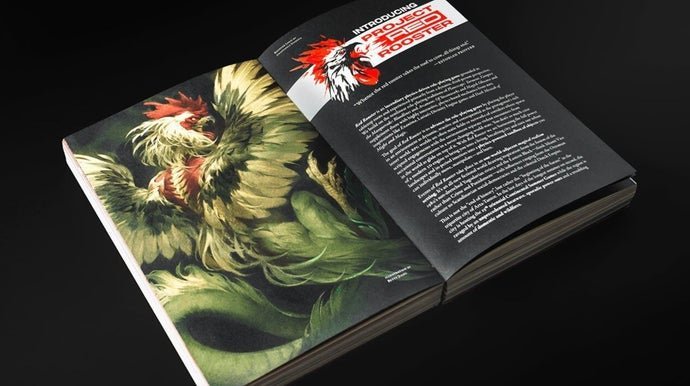
The studio announced the project through a 500-page anthology that combines studio manifesto, developer interviews, and an extensive lore bible and pitch document for the game. The book situates Summer Eternal within contemporary video game industry debates, featuring essays on aesthetics, generative AI, and the challenges of pursuing anti-capitalist game development while navigating commercial funding requirements. The anthology includes open-ended interviews with former BioWare developers Mark Darrah and David Gaider, science fiction novelist Ted Chiang, Marxist economist Richard Wolff, and union organisers from United Videogame Workers-CWA.
A City Divided by Fire and Water
Red Rooster takes place in Arta-Trantor, a magic realist city built in Unreal Engine that exists adjacent to our own world. The setting is characterised by extreme flammability and deep internal divisions, comprising three nested "member-territories" shaped by centuries of warfare, rivalry, and overseas exploitation. A central thematic conflict between fire and water runs through the city's history and factions. The game world functions as a physics-powered sandbox where individual objects can be moved, manipulated, and burned, with a simplified but realistic real-time fire simulation that spreads between surfaces according to material properties.
The city's geography creates bizarre spatial constraints and possibilities. International borders crisscross streets, bisect buildings and bedrooms, and create enclaves within neighbourhoods. Players navigate soft borders as they explore, which generate unusual gameplay scenarios: crossing a street might move you into a different jurisdiction to evade law enforcement, or crossing a bar at a specific time could allow you to continue drinking in a territory with more lenient alcohol laws. Windows and unconventional routes become necessary when border policies shift, forcing players to find alternatives to standard doors.
Arta-Trantor undergoes constant change and entropy independent of player activity. Lightbulbs burn out, falling leaves accumulate on staircases, trash bags are emptied, and local sculptors gradually transform stone into statues. These phenomena exist within a web of terrain factors imposed by the city's tripartite political culture, creating a topologically complex map that fundamentally shapes how players navigate and interact with the world.
The Protagonist and Inner Voices
Players assume the role of Redrick Roost, a convict serving a life sentence after accidentally rendering thousands of people catatonic through a malfunctioning "auto-meditation" headset called the Baku device. Like Harry Du Bois from Disco Elysium, Redrick inhabits a fractured psyche populated by competing voices and alternate selves. Following the headset malfunction and resulting mass mental fracturing, Redrick developed the Coop, an eerie inner sanctum modelled after a vacuum shop where he once worked. This mental space houses multiple Rooster-selves that vie for dominance throughout the game, directly affecting dialogue options and available abilities.
Redrick's tragic history shapes his character. His parents died in a house fire during his childhood. At age twelve, he was seduced by a school science teacher who was later imprisoned not for statutory rape but for commandeering a postal vehicle. As an adult, Redrick became involved with the inventor of the Baku headset, whose marketing exploited the infamy surrounding his "affair" with the teacher. This complicated past informs his characterisation as earnest, apologetic, and somewhat detached from reality.
The Rooster-selves function as a character progression system. Players spend experience points to modify their build while interacting with various Rooster personalities, who may form factions as they compete to shape Redrick's overall persona. Possible Roosters include a Rooster-Raconteur unable to stop debating people, a pathological gambler, and an Overkompensaaator who wears sunglasses indoors. Additional Roosters emerge as the game progresses, and players decide whether to admit, strengthen, or repress them to alter Redrick's statistics and dialogue options, mirroring the Copotype system from Disco Elysium. Repression functions as a dice-driven encounter with multiple possible outcomes beyond simple victory or failure. Repressed or rejected Roosters can push through and hijack the Coop if players consistently behave according to their archetype.
The Mathematician and the Mystery
Redrick's initial companion is Dr Astrid Albers, a mathematician working at a local research institute who is defined by her claustrophobic relationship with her overbearing novelist father, her tendency toward deception, and a profound realisation that the laws of mathematics have fundamentally altered. This mathematical breakdown extends to the bones of the prime number system itself, an event potentially connected to an ongoing heatwave affecting the city. Astrid teams up with Redrick after being caught overdosing on opiates and forced into a state-supervised rehabilitation program, where her assignment is to monitor Redrick while he investigates a fire station arsonist.
Astrid's visual inspirations include musician Patti Smith and the character Gollum, giving her a striking stage presence that contrasts sharply with Redrick's understated demeanour. Both characters utilise a rhizomatic clothing system where players establish eerie fashion synergies on a grid rather than navigating traditional equipment screens organised by body part.
Redrick's primary objective, assigned by government operatives who recruited him, is to identify the arsonist working at a fire station run by his own hero brother. Players have one week to solve this mystery before Redrick's parole hearing, creating a time-pressure narrative framework.
Physics as Narrative Tool
Game director Argo Tuulik frames the manipulable object world as a key differentiator for Red Rooster. He describes the physics system as essential to the game's identity: the visceral connection developed through numerous small interactions forms the connective tissue between gameplay and narrative, providing the physical counterpart to reactive psychological roleplay and representing the logical next step in RPG design.
The game allows players to lob and break objects with varying weight, fragility, and elasticity, from chairs to bicycle tyres. Acts of arson serve as methods to pursue particular subplots and revelations, though not all world elements are combustible. Fire becomes central to Redrick's characterisation, reflecting his traumatic relationship with the element while simultaneously serving as a tool for investigation and environmental manipulation.
Studio Philosophy and Funding
Summer Eternal founder and former ZA/UM narrative designer Dora Klindžić articulates the studio's ideological commitment through the anthology. The book features a double-page spread depicting the red rooster striking down a vulture representing venture capitalism, while Klindžić criticises what she calls "bourgeois virgins who administrate their battles from office desks." She writes of preparing "a conflagration, an end to mourning, an end to the poison fog of demoralization and the apathy tears of the mentally imprisoned," declaring that the studio exists "to give you something to hope for" and "to give you something to believe in."
The studio operates as a worker co-operative with a share structure dividing equity between creatives and investors, with a small portion reserved for fans. This structure reflects Summer Eternal's commitment to anti-capitalist game development principles, though the studio acknowledges the necessity of compromise regarding funding requirements. The anthology addresses these tensions directly through essays on aesthetics, generative AI, and the practical difficulties of maintaining ideological consistency within commercial constraints.
Red Rooster remains in early pre-production with three to four years of development ahead, assuming Summer Eternal successfully secures the necessary funding. Much of what has been revealed may change during development, and the studio makes no secret of its ongoing fundraising efforts. The 500-page anthology serves as both a manifesto for the studio's values and a comprehensive pitch document for the game itself, representing an unusual approach to game announcement that prioritises ideological context alongside mechanical and narrative details.
Related Articles
About the Author