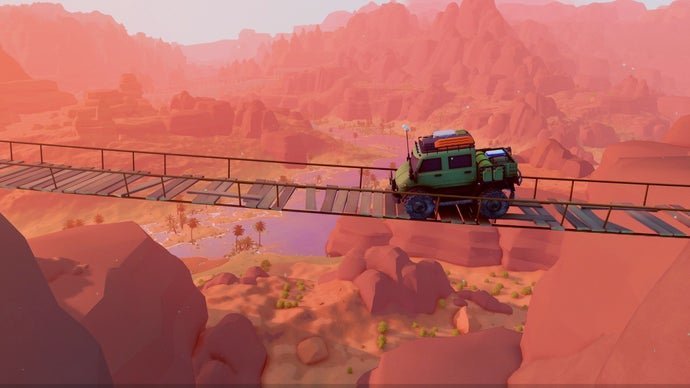
Over the Hill, the latest release from Funselektor, presents a more approachable take on the demanding off-roading simulation genre exemplified by titles like SnowRunner. The studio behind Art of Rally and Absolute Drift has crafted wilderness environments set in the Canadian hills and the Algerian desert, offering players a chance to explore these landscapes with a more relaxed philosophy than the genre's tougher competitors.
The game's core appeal lies in its balance between accessibility and genuine challenge. Players pilot various four-wheel-drive vehicles across treacherous terrain, equipped with tools like winches and jacks to extract themselves from precarious situations. The progression system rewards exploration, granting upgrade points for discovering and interacting with objectives scattered throughout the world. These points unlock additional tool slots and vehicle upgrades that prove essential for tackling increasingly difficult terrain.
Simplified Mechanics with Real Consequences
Unlike the intricate systems found in hardcore off-roading sims, Over the Hill streamlines its mechanical complexity significantly. Players can switch between high gear for speed and low gear for climbing hills without wheelspin, but the game omits features like differential locks, fuel management, and extensive vehicle tuning menus. This stripped-down approach dramatically lowers the learning curve, allowing newcomers to jump in without consulting extensive documentation or spending hours mastering obscure settings.
However, this simplification does not eliminate consequences for poor driving decisions. The terrain remains genuinely treacherous, with angular rocks capable of flipping vehicles just as effectively as in more complex simulators. Careless navigation around bends or excessive speed descending mountain trails can leave players wedged between rocks or tumbling down cliffsides. The game's forgiving checkpoint system, which places camps nearby for quick restarts, softens these failures without removing the tension entirely.
The tool slot system creates an interesting resource management layer. Early in the game, players possess only a single tool slot, forcing difficult choices about whether to equip a winch or jack. As they progress and unlock additional slots—up to four total—they gain more options for self-rescue. Yet even with a full complement of tools, success is not guaranteed. Situations arise where no nearby tree exists to anchor a winch, or where multiple mistakes in succession exhaust all available recovery options, necessitating a return to camp for repairs.
Terrain Variety and Environmental Challenges
The Canadian maps introduce weather dynamics that significantly alter driving conditions. Snowfall transforms terrain into treacherous, soupy ground, with vehicles becoming partially or completely buried if left stationary during storms. Players can pause or rest at cabins to let time pass, only to discover their jeep half-submerged upon resuming travel. The Algerian maps present different challenges, with sandy dunes and rocky mesas creating their own hazards. These environmental variations prevent the experience from becoming monotonous, as different regions demand different approaches.
The game's aesthetic contributes to its distinctive personality. The lo-fi visual style creates a contemplative atmosphere that encourages leisurely exploration rather than frantic rushing. This design choice pairs well with the simplified mechanics, fostering what players describe as zen-like vibes while navigating wilderness. The landscape itself becomes a character, with striking ruins woven into the Algerian terrain and varied topography across the Canadian regions.
Interestingly, the game includes a photography mechanic that rewards players for capturing wildlife. Deer, foxes, and other animals populate the environments, and documenting them yields rewards. This feature encourages players to slow down and observe their surroundings rather than beelining toward the next objective. Players who overlook this mechanic early may find themselves frustrated later, unable to recall where they spotted particular animals hours after the fact.
Vehicle Progression and Garage Management
Players gradually accumulate a diverse garage of vehicles by completing challenge trails that establish checkpoint routes through difficult terrain. These trails range from relatively straightforward paths to genuinely punishing courses that demand careful navigation and precise vehicle control. Successfully completing these challenges unlocks new vehicles, each with distinct characteristics suited to different situations.
One standout vehicle, nicknamed Das Mammoth, represents a high-end unlock available relatively early in progression. This Unimog-shaped behemoth features exceptional ground clearance and upgraded technology, making it capable of overcoming most obstacles encountered in the game. Its effectiveness raises questions about vehicle balance, as players may find themselves reluctant to pilot other unlocked vehicles when one option proves so dominant. Classic vehicles like Land Rover Defenders and Ford Broncos occupy the garage alongside more modern pickups and wood-paneled station wagons, yet none seem to match Das Mammoth's elite capabilities.
A notable frustration emerges from the upgrade system's design. Improvements purchased for one vehicle cannot transfer to others, meaning each new addition to the garage must be tuned from scratch. This design choice discourages experimentation with newly unlocked vehicles, as players hesitate to take unupgraded machines into unexplored territory where dangerous wildlife and challenging terrain await. The system inadvertently pushes players toward relying on their most capable, fully-upgraded vehicle rather than exploring the variety the game offers.
Accessibility and Platform Availability
Over the Hill's approachable design extends to its platform availability. The game runs on Steam Deck, making it suitable for portable play sessions. The pick-up-and-put-down nature of the experience suits handheld gaming well, allowing players to enjoy brief excursions into the wilderness without requiring extended play sessions. This accessibility represents a significant advantage over more demanding off-roading simulators that require sustained focus and complex input management.
The manual transmission option, while available, proves counterintuitive to the game's overall philosophy. Enabling manual transmission adds mechanical complexity that disrupts the contemplative atmosphere, drawing players out of the zen vibes that define the experience. Most players find themselves disabling this option quickly, recognizing that the automatic transmission better serves the game's relaxed approach.
Multiplayer and Long-Term Engagement
The game supports cooperative multiplayer, allowing players to coordinate expeditions into the wilderness together. This feature remains underdeveloped in early impressions, though the potential for shared exploration appeals to those seeking social off-roading experiences. The multiplayer component may provide long-term engagement once players exhaust the single-player content.
Collectibles and photography objectives offer goals beyond simply reaching new locations. Meteorites scattered throughout the landscape provide targets for dedicated explorers, while wildlife photography encourages players to slow down and observe their surroundings. These secondary objectives promise to sustain engagement once players have charted most available terrain and exhausted the challenge trails.
Position Within the Genre
Over the Hill occupies a unique position within the off-roading simulation landscape. It lacks the depth and complexity of hardcore simulators like SnowRunner, yet maintains enough challenge and physics authenticity to feel consequential. The game succeeds in making off-roading accessible without trivializing it, creating an experience that appeals to players intimidated by the genre's traditional complexity while still satisfying those seeking genuine challenge.
Funselektor's approach reflects the studio's broader philosophy of exploring different automotive experiences. Their catalog includes drift games, rally simulations, and retro F1 management titles, each bringing unique perspectives to car-focused gameplay. Over the Hill continues this pattern of experimentation, proving that off-roading simulations need not follow the hardcore template established by existing leaders in the genre. The game demonstrates that there is room for alternative approaches that prioritize accessibility and atmosphere without abandoning the tension and consequences that make off-roading compelling.
Related Articles
About the Author