Forbidden Solitaire demonstrates the power of cohesive thematic design to transform familiar mechanics into a compelling experience. The card game, developed by Grey Alien Games, takes the core solitaire systems the studio has refined across multiple releases and wraps them in a horror-tinged narrative that gives fresh meaning to every interaction.
Theme in games represents a delicate balance. A well-designed game can falter if its mechanics feel disconnected from its visual presentation, story, and overall framing. When mechanics and theme work in harmony, the result is seamless and engaging. When they clash, the dissonance becomes impossible to ignore. Developers may sometimes seek that friction intentionally, but more often it emerges by accident and undermines the experience.
A Decade of Refined Mechanics
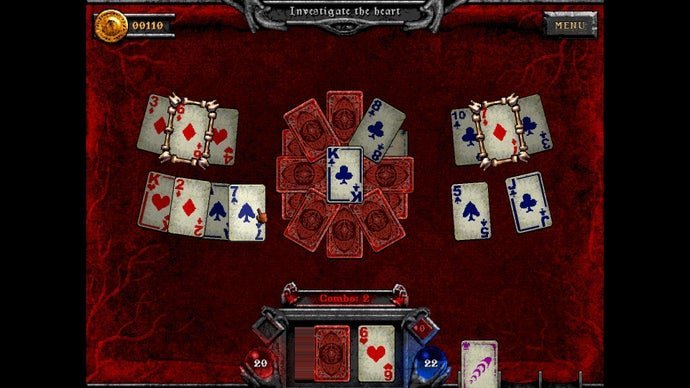
Grey Alien Games has built its reputation on a consistent foundation. Since releasing Regency Solitaire in 2015, the studio has returned repeatedly to the same core system. Each game presents a screen filled with stacked playing cards. Players clear the screen by selecting cards that are one value higher or lower than the card currently held. The basic loop remains constant, but the studio has layered in variations. Padlock cards require matching key cards to clear. Special cards reshuffle entire stacks. Others transform cards into different suits or numbers to aid progression. Despite mechanical consistency, each release—Regency Solitaire, Shadowhand, Ancient Enemy, and now Forbidden Solitaire—recontextualizes these systems through different scenarios, demonstrating how theme can make familiar mechanics feel fresh.
A Game Within a Game
Forbidden Solitaire sets itself in 2019, but the player character discovers a mysterious CD-ROM from 1995 in a second-hand shop. The disc contains a game from childhood, one remembered mainly for the controversy surrounding its launch. The narrative frames the card-clearing mechanics as dungeon exploration. Locked doors, labyrinths, and enemies all present themselves as card puzzles to solve. Familiar special cards return, including the stack-shuffling variant. As the player progresses deeper into the dungeon, messages arrive from the character's sister in the present day. She researches the game and the scandal it caused, sending police reports, news clips about the secretive developer, and documents revealing a centuries-old cult connected to the game's creation.
This layered framing creates space for both new and returning players to engage with the material. Newcomers benefit from the 1995 game device, which justifies the simple card mechanics while drawing them into a kitsch horror narrative about cultists developing haunted video games. For players familiar with Grey Alien Games' previous work, the appeal lies in recognizing how old tools have been repurposed to serve the new story.
Mechanics Meeting Narrative
The integration of mechanics and story reaches its strongest moments when the two reinforce each other directly. When a player encounters a character marked for sacrifice tied to a bed, the level designed to free them fills the screen with locks. These locks disappear only when the player matches enough cards of the same suit. The act of matching cards becomes the act of untying the character. This pairing of a mechanic that has existed in Grey Alien Games' work for at least a decade with a specific narrative moment creates perfect alignment. The action and the story dovetail seamlessly, making the mechanical interaction feel purposeful and thematically resonant rather than arbitrary.
The Power of Thematic Coherence
This approach to theme elevation is not new to Grey Alien Games. When Regency Solitaire launched in 2015, reviewers immediately recognized how effectively the studio had used theme to enhance its card mechanics. The game was praised as a superb example of how solid design becomes something greater when paired with strong thematic grounding. The implementation avoided excess—it included atmospheric backgrounds, a handful of characters, and brief conversations that established tone without overwhelming the player through extended exposition or heavy-handed storytelling. The game demonstrated awareness of its own scope and scale, maintaining a tone that felt well-mannered and unobtrusive. The thematic elements served as rewards for completing card puzzles rather than distractions from them.
That same philosophy carries through to Forbidden Solitaire. The horror framing, the cult narrative, and the sister's present-day investigation all provide context and motivation for the card-clearing loops. Without this thematic wrapper, the game would present as a straightforward puzzle experience. With it, each level gains narrative weight. The mechanics become tools for exploring a story rather than abstract challenges.
A Lesson in Game Design
Forbidden Solitaire ultimately illustrates a fundamental principle: the strength of a game's theme can elevate mechanics that might otherwise feel dated or repetitive. The core solitaire system has remained largely unchanged across Grey Alien Games' releases, yet each game feels distinct because the theme recontextualizes what the player is doing. In Regency Solitaire, you manage estates and social obligations. In Shadowhand, you navigate a fantasy world of magic and mystery. In Forbidden Solitaire, you descend into a horror-filled dungeon while uncovering a decades-old conspiracy.
This recontextualization demonstrates that mechanical innovation is not the only path to creating engaging games. A developer working with familiar systems can still produce fresh, compelling experiences by investing in cohesive thematic design. The theme must feel integral to the mechanics, not applied as a thin veneer. When theme and mechanics work together, the result transcends what either element could achieve alone. Forbidden Solitaire stands as evidence that a strong thematic foundation can transform even decade-old systems into something worth experiencing.
Related Articles
About the Author