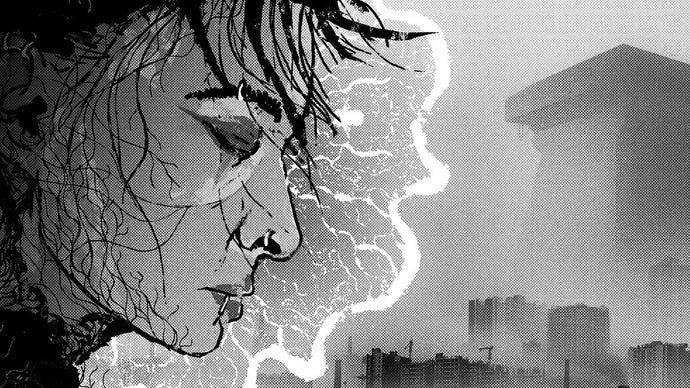
Gareth Damian Martin, the solo developer behind the acclaimed Citizen Sleeper series, is taking a significant creative leap with Signet City, a first-person role-playing game announced at Summer Game Fest that challenges conventional notions of what RPGs can be. The project represents an intentional effort to expand the genre's scope, drawing on Martin's success with Citizen Sleeper to explore more experimental territory.
Martin has long felt a responsibility to push the medium forward. Having achieved rare success as an independent solo developer, they view this position as an opportunity to contribute meaningfully to the industry's direction. The ambition behind Signet City stems from a desire to make RPGs as varied and rich as tabletop role-playing games, which encompass far more diversity than most video game interpretations of the genre.
The game's announcement trailer presented a striking visual aesthetic: black and white, industrial, and bleak, filled with thick lines and post-punk sensibility. The descriptor "fungalpunk" immediately set it apart—a term Martin had been developing for nearly a decade. The premise is equally unconventional: players take on the role of a fungal parasite inhabiting the minds of people living in a fictional 1980s British city undergoing de-industrialisation.
Origins in unexpected places
The concept originated from an unlikely source: Martin's previous work in theatre design for Sting's musical production The Last Ship. The show explores Sting's childhood in Wallsend, a Newcastle town devastated by shipyard closure. While researching 1980s Newcastle for that project, Martin encountered images of massive ships looming over terraced houses—a visual conflict between industrial scale and domestic life that felt almost science-fictional.
That imagery remained with Martin for years, eventually crystallising into the world of Signet City. Over nearly a decade, they accumulated references and material, gradually constructing a fictional industrial city with a completely different economic foundation than Newcastle, layered with the strange technology of fungalpunk. The setting represents an overlooked period in British entertainment, one that Martin felt warranted exploration in gaming.
The fungalpunk concept itself is surprisingly literal. Martin describes it as being "fungal in a very true sense"—the player is a fungal parasite, and the game explores themes of decay and reinvigoration, processes closely associated with fungi. One guiding principle Martin uses for the project is the idea of being "a fungal superhero," a phrase inspired by the 1989 Japanese film Tetsuo: The Iron Man, which follows a salary worker gradually transforming into metal.
Martin admires that film's commitment to visceral bodily transformation and its strange beauty. The fungalpunk concept applies similar logic to human-fungal integration, acknowledging that humans already harbour bacteria and fungal infections—we are, as Martin notes, multitudes. This biological foundation gives the game's premise an unsettling grounding in reality.
Post-punk as political framework
The punk element refers to the post-punk cultural and musical movement of the 1980s, often overshadowed by more aggressive punk but equally anti-establishment, though darker and more nihilistic. Post-punk engaged with structural politics and transgressive fiction, channelling complex ideas through music—think Joy Division's references to novelist JG Ballard. Martin sees this cultural moment as rich territory for an RPG, and the game's aesthetic, music, and setting all channel these influences.
The gameplay mechanics build on foundations established in Citizen Sleeper but adapted to the first-person perspective and parasitical premise. Players choose an area of the city, then inhabit a host character's mind for a day. The trailer shows the beginning of one such story: a character named Sid wakes in a river just as the player-parasite awakens in her mind. Players control the host character using first-person controls similar to games like Dishonored or Skyrim.
Instead of direct action, most significant tasks require dice rolls modified by skills, echoing Citizen Sleeper's core mechanic. To accomplish something difficult, players must manipulate their host's emotional state. If kicking down a door requires physical strength, the parasite must provoke the host into anger, perhaps by engineering an argument with coworkers. This generates both narrative consequences and mechanical benefits—anger increases physical strength modifiers.
Emotions as mechanical resources
Skills in Signet City are intrinsically tied to emotion. The parasite's job is identifying emotional triggers and amplifying them to increase chances of success. At day's end, the extracted emotional energy becomes a permanent resource for improving the host's skills. This system means players gradually reshape their hosts, pushing them toward particular emotional states and capabilities.
However, this comes with lasting consequences. Making someone repeatedly angry doesn't just provide mechanical benefits—it changes who they become. Their personality shifts, their future decisions alter, and their story continues even when the parasite moves to another host. This creates a web of consequences across the city's population, with each host's arc shaped by the player's parasitical influence.
Martin hasn't fully revealed what parasites actually want or need to accomplish. They describe it as having objectives that emerge through sensory experience—voices, attractions, tastes, and smells guiding the parasite toward different places. The overarching goal involves growth and gaining power, though the ultimate purpose remains initially obscure to the player.
The parasitical framing itself serves a narrative purpose. Martin notes that tabletop RPG players are often parasites in relation to characters—pushing them around, speaking for them, sometimes using their names and sometimes their own. Signet City simply makes this dynamic explicit and plays it into the fiction. This acknowledgement allows for a different kind of character relationship.
Hosts as autonomous characters
Because the player inhabits rather than controls the host, characters retain autonomy and their own motivations. They're not thoughtless mannequins awaiting direction but people already embedded in situations, already dealing with complications. Dropping into their minds means entering mid-crisis, which Martin finds more dramatically compelling than the typical RPG pattern of characters waiting to explain their problems to a stranger.
The ability to read hosts' minds also creates intimacy impossible in traditional games. Players understand characters' thoughts and feelings without requiring unnatural exposition or immediate trust. There's no need for NPCs to suddenly reveal their life stories to someone they've just met. Instead, the core relationships exist between parasite and host, built on direct mental access rather than dialogue.
Martin describes a layer existing above the host's conscious thoughts where the parasite lives and functions—a realm of feelings, emotions, and sensory reactions to the external world. This layer is deliberately bizarre and alien, presenting its own challenges. Describing what it feels like to be a parasite inhabiting a human mind, and making that experience comprehensible to players, represents one of the game's central creative challenges.
Development status and release timing
When Martin and I spoke in summer, Signet City was only halfway through development, with no release date announced. The early announcement served multiple purposes: clarifying that this isn't Citizen Sleeper 3, and giving people time to absorb and process an unconventional concept. Martin worried that without preparation, the game might be misunderstood or overlooked entirely.
Martin has characterised Signet City as a significant risk—"the biggest swing I have ever taken." They felt genuinely nervous about the announcement, though some anxiety had subsided by our conversation. That nervousness stems not from industry or financial concerns but from fundamental creative doubt: whether they can still produce things that appeal to people based purely on personal tastes and obsessions.
Martin's primary worry is whether Signet City will actually be interesting to an audience. They acknowledge the game is different enough that some people might not connect with it, but they're betting on finding their audience. "I'm betting on the sickos," Martin says, explaining that their obsessions tend to be sticky, resonating with others who enjoy being tourists in other people's creative fixations. That willingness to embrace niche appeal, combined with the originality evident in Signet City's premise and design, suggests Martin's confidence may be justified.
Related Articles
About the Author