Company of Heroes 3's Operation Torch campaign finally arrives as a substantial singleplayer expansion, delivering 15 missions set across the North African theatre. The expansion follows two US officers as they work to dismantle the German Afrika Korps' control of the region. After three years of waiting while Relic focused on multiplayer roster expansions, Operation Torch promises a welcome return to the game's singleplayer experience. However, the campaign's execution proves more complicated than its premise suggests.
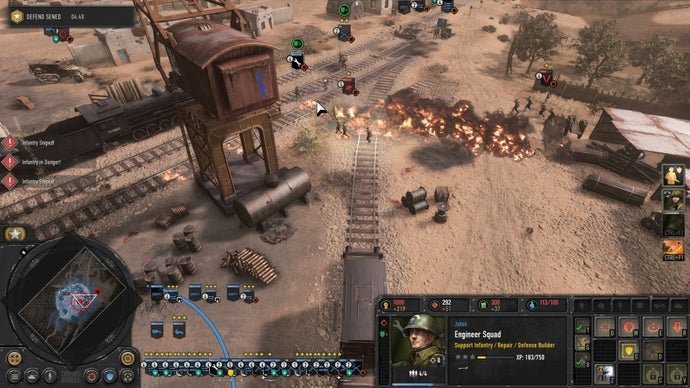
The campaign's strongest moments emerge when multiple objectives demand simultaneous attention. Midway through, a mission tasks the player with managing a full retreat under German pressure. While holding back enemy forces at the map's front, a supply truck must be driven between structures to evacuate their crews. The tension of balancing a crumbling defensive line against a vulnerable evacuation objective captures Company of Heroes at its finest, forcing constant tactical decisions under duress. German units actively push through gaps in the player's defences, and a single well-positioned anti-tank gun threatens the entire evacuation. These sequences showcase the series' strength: commanding controlled chaos across a dynamic battlefield.
Scripted Missions Undermine Potential
Unfortunately, Operation Torch squanders these moments almost as quickly as they arrive. After the evacuation phase concludes, the mission shifts into a scripted sequence where the player must deploy two sniper squads to eliminate German officers searching abandoned buildings for intelligence. While the premise sounds engaging, the mission's mechanical design makes it tedious rather than tense. The player's weakened army sits on a hill overlooking the town, but German forces never advance toward it. Inside the town, German units either remain stationary or follow small, predictable patrol loops. Navigating the cloaked sniper squads between them becomes a slow exercise in patience rather than a test of skill. When the snipers break stealth to eliminate their targets and are spotted by German soldiers, those enemies simply walk away without pursuing. The scripted nature of these encounters removes the unpredictability that makes Company of Heroes compelling.
This passive AI behaviour extends throughout the campaign. Across multiple missions, the same exploitative tactic proves devastatingly effective: send a unit with stealth capabilities to hide invisibly behind cover near enemy positions with orders to hold fire. Use this infiltrator as a forward spotter while pummelling the enemy with mortars from a safe distance. The enemy never fights back aggressively, making the tactic work repeatedly. While the player recognizes that this approach is not fun—turning every engagement into a slow war of attrition—it becomes too effective to abandon when the AI refuses to mount a real counter-attack. This difficulty setting may be standard, but the overall AI passivity suggests a deeper design issue rather than a tuning problem.
Historical Narrative and Map Design
Despite the mechanical shortcomings, Operation Torch's narrative unfolds in genuinely interesting ways. The campaign captures the historical character of the North African theatre, where rapid Allied advances frequently reversed into equally swift retreats. Rather than pushing forward relentlessly, many missions require holding defensive positions while covering routed allied forces or defending key terrain until air support arrives to break the German momentum. This ebb-and-flow structure creates natural narrative variety.
Relic leverages this back-and-forth combat to employ one of the best tricks available in real-time strategy design: reusing the same map from different perspectives. A mission might task the player with assaulting a town street by street to break the Afrika Korps' grip on the location. Several missions later, the same terrain becomes a defensive battleground as German forces mount a counter-attack. This approach should create a satisfying sense of territorial struggle, with both sides fighting over the same ground from different angles. In theory, this design choice reinforces the campaign's historical themes and creates meaningful strategic variation. In practice, the same push-and-pull dynamic fails to materialize on the battlefield itself, undermined by the scripted mission design and passive enemy behaviour.
Progression and Perk System
Relic has introduced a new progression mechanic to Operation Torch: mission-end unlock choices that grant passive and active perks applying throughout the campaign. After completing a tank-focused mission, the player might choose between a passive perk that makes Shermans 25 percent harder to hit while moving or an unlock for a different Sherman variant in the motor pool. Completing optional objectives grants additional choices, such as reducing tank production costs by 10 percent or producing all tanks at veterancy level 3. By the final mission, the right side of the screen displays a substantial stack of accumulated perks.
The concept of gradually developing force capabilities across a campaign holds genuine appeal. However, the execution falls short of creating meaningful gameplay impact. The individual perk bonuses—slightly cheaper units, marginally improved durability—fail to produce tangible differences in how missions play out. Making tanks cheaper or harder to hit does not substantially alter the tactical experience when engaged in close-quarters combat. The system needed more dramatic differences between choices to justify the progression framework. As implemented, the perks feel like minor statistical adjustments rather than meaningful campaign-long decisions that shape how the player approaches each mission.
Difficulty and Future Prospects
The campaign's reliance on scripted encounters and passive AI suggests that Operation Torch may play better at higher difficulty settings. Standard difficulty appears to have been tuned with less aggressive enemy behaviour, which exacerbates the scripting issues. A player willing to crank the difficulty slider upward might find the missions more challenging and less susceptible to the cheesing tactics that work so effectively on standard settings. However, the fundamental design of scripted sequences remains unchanged regardless of difficulty level.
While Operation Torch fails to fully deliver on its potential, it does not represent a dead end for Company of Heroes 3's singleplayer expansion. Relic has demonstrated willingness to experiment with new mechanics and systems, and the campaign's narrative framework—built around the historical North African campaign—provides solid thematic grounding. The developer has shown interest in continuing to flesh out the game's singleplayer content, and there remains considerable scope for future campaigns. Whether Relic will address the scripting and AI issues that plague Operation Torch remains to be seen.
Related Articles
About the Author